
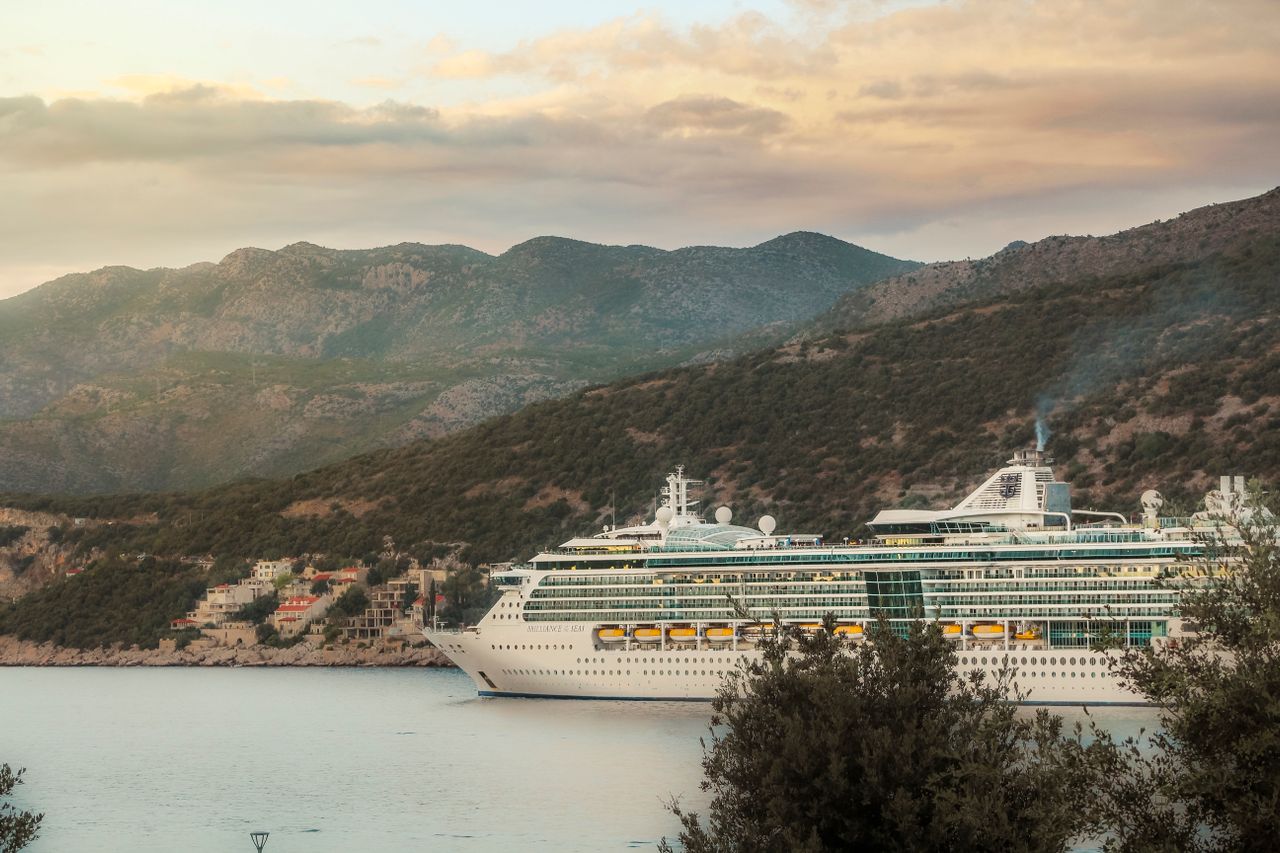
When do cruise ships dock in Dubrovnik?
Cruise ships dock in Dubrovnik most days between March and November. Typically they arrive early in the morning and leave again by early evening. There is no single fixed schedule, since it depends entirely on which lines have ships in port that week, so the only reliable way to know for a specific date is to check the current cruise ship schedule for Dubrovnik.
Dubrovnik’s population is around 42,000, while the city receives close to a million cruise passengers a year on top of its other visitors, a scale that’s central to why the city introduced its current visitor limits. A single mega-ship can carry more passengers than the entire population of Dubrovnik’s Old Town. This, of course, effects the crowd density in the city.
Below is why the timing works the way it does, how to check it yourself, what a heavy day actually looks like hour by hour, and what to do with your time if you land on one.
Why cruise ships arrive when they do?
Most cruise itineraries reach Dubrovnik early, typically between 7am and 9am, because ships usually sail overnight from their previous port, commonly Venice, Bari, Split, Kotor or Corfu on Adriatic routes. Arriving first thing gives passengers a full six to eight hours ashore before the ship needs to depart in the late afternoon or early evening for its next stop.
That fixed window is also why the Old Town so reliably empties out again by early evening. Unlike a hotel or apartment guest, a cruise passenger’s entire visit to Dubrovnik is bound to the ship’s schedule, which is the single biggest reason the city’s daily rhythm on a cruise day looks so different from a quiet one.
Where the ships dock in Dubrovnik?
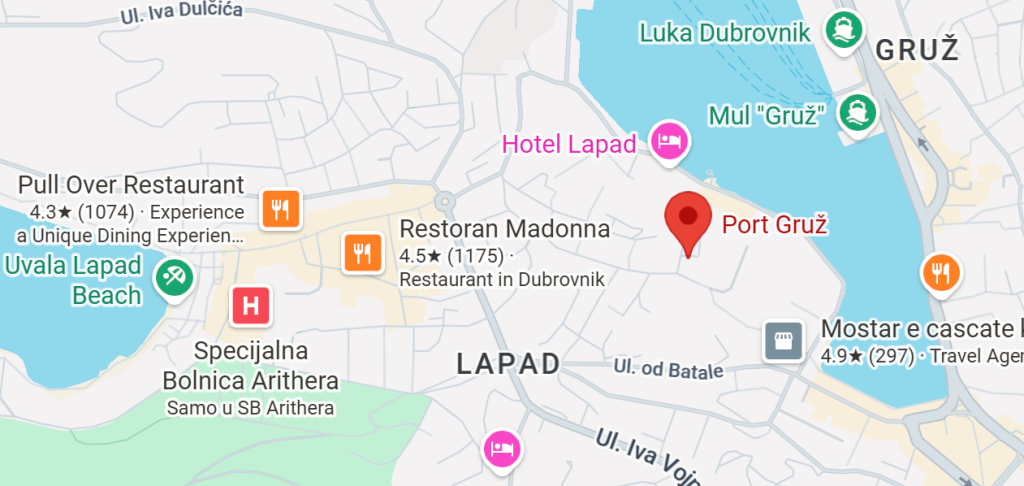
Almost all cruise ships dock at Port Gruž, about 3 kilometres northwest of the Old Town, not in the Old Town itself. From there, getting into the city takes one of a few forms: a shuttle bus organised by the cruise line, if one is offered, a taxi from the rank right at the port, or Libertas city bus routes 1A, 1B or 3, which all run between Gruž and the Old Town. Figure on roughly 10 minutes by taxi, about 15 minutes by local bus, or somewhere around 35 to 40 minutes on foot if you’d rather walk the whole way. A small number of smaller ships anchor directly off the Old Town instead and tender passengers straight into the Old Harbour, cutting that transfer down to a few minutes, and it’s worth remembering these tender arrivals are easy to miss if you’re only counting berths at the main port.
How many ships come depends on a formal agreement between the Dubrovnik Port Authority and the County Port Authority, which limits calls to a 2+1 arrangement: two large ships at the main port plus one anchored in front of the Old Town, keeping most days at or under roughly 8,000 cruise passengers. According to the Port Authority’s own figures, only around 18 days a year go above that 8,000 mark, mostly concentrated in July and August, meaning more than 90 percent of cruise days stay below it. Just a handful of days a year pass 10,000. Most days, in other words, are genuinely manageable, and the exceptions are predictable if you check ahead.
Ship size varies enormously, which is worth keeping in mind when you’re reading a schedule rather than just counting entries. A modern cruise ship typically carries somewhere around 2,500 to 3,500 passengers, but the range runs from small expedition and yacht-style ships with a few hundred guests up to mega-ships carrying well over 5,000.
Two ships on a given day could mean anywhere from under a thousand extra people in town to close to the full 8,000 cap, depending entirely on which vessels they are. Across a full year, Dubrovnik receives more than 600 cruise ship calls carrying close to 900,000 passengers, a scale that’s part of why the city introduced the visitor caps and scheduling limits in the first place.
How to check the schedule for your own dates?
The most reliable source is the Dubrovnik Port Authority’s own arrivals and departures page, which lists exactly which ships are booked into port on any given date. A few independent sites mirror this data in an easier-to-scan format, useful for browsing a whole month at a glance.
- Official source: Dubrovnik Port Authority, arrivals and departures
- Independent schedule tool: Cruise Timetables
Check again close to your travel dates, since cruise itineraries do change, and a date that looks quiet in the Dubrovnik cruise schedule pulled six months out isn’t guaranteed to stay that way.
If you’re still choosing which month to travel in, the seasonal pattern is a reasonable first-pass guide before you narrow things down to specific days.
| Month | Cruise traffic |
|---|---|
| March | Low |
| April | Moderate |
| May | High |
| June | High |
| July | Very high |
| August | Very high |
| September | High |
| October | Moderate |
| November | Low |
Once you do have a date and a ship count in front of you, here’s roughly what that number translates to on the ground.
| Ships in port | What to expect |
|---|---|
| 0 | Very quiet. The Old Town feels close to how it does off-season. |
| 1 | Comfortable. Noticeably busier around midday, but easy to move around. |
| 2 | Busy but manageable. Stradun and Luža Square fill up between late morning and mid-afternoon. |
| 3 or more | Plan around it. Treat the 10am to 4pm window as one to spend elsewhere. |
What a cruise ship day actually looks like?
Even on a heavy day, Dubrovnik doesn’t stay crowded all day. The pattern is fairly consistent.
| Time | What it’s like |
|---|---|
| 7am to 9am | Quiet. Passengers are still aboard having breakfast; the Old Town belongs mostly to residents and early risers. |
| 9am to 10am | Building. Tender boats and shuttle buses start bringing passengers ashore. |
| 10am to 4pm | Peak. This is the window when the Old Town feels genuinely crowded on a heavy ship day. |
| 4pm to 5pm | Thinning out. Passengers start heading back toward the port for departure. |
| 5pm onward | Calm again. Most ships have sailed, and the evening light is some of the best of the day for photos. |
Quieter corners of the Old Town when it is busy
If you’re in the Old Town during the busy window regardless, where you walk still makes a real difference.
Buža Gate instead of Pile or Ploče
Most visitors funnel through Pile Gate or Ploče Gate, which is exactly why both get congested first. Buža Gate, next to the University of Dubrovnik, is a smaller, lesser-used entrance that leads straight into the quieter northern alleys rather than onto Stradun itself.
The side streets north of Stradun
Stradun itself is the main artery and fills up fastest. The narrow parallel streets just north of it carry a fraction of the foot traffic and are often only a minute’s walk from the main street.
St John’s Fortress entrance to the City Walls
The City Walls have three entry points, and most visitors use the two near Pile and Ploče Gates. The third, at St John’s Fortress near the Old Harbour, tends to have noticeably shorter queues. Walking the City Walls before 9am, regardless of which entrance you use, is one of the easiest ways to avoid both the cruise crowds and the strongest summer heat at the same time.
Common mistakes
A few assumptions catch people out even after they’ve checked the schedule.
- Assuming a “zero ship” day means an empty Old Town. It means no cruise crowd specifically, but independent travellers, hotel guests and day-trippers from elsewhere on the coast are there regardless. It’s quieter, not empty.
- Checking the schedule once, months in advance, and never again. Cruise itineraries shift more often than people expect. A date that looked clear in January can pick up an extra call by June.
- Assuming rain cancels the crowds. It doesn’t. Ships still dock and passengers still come ashore in poor weather, they just spend more time under cover in cafés and covered streets rather than out on the walls, which can make the Old Town’s indoor spots busier than usual.
- Not booking a lunch table on a day you know is heavy. Restaurants along Stradun and near the main gates fill up fast on multi-ship days. A short walk to a side street, or a reservation made the day before, avoids the wait.
The advantage of staying overnight
Cruise passengers only get six to eight hours ashore, all of it inside the busiest part of the day, but anyone staying in Dubrovnik overnight can shift their own schedule around that window entirely. Walk the City Walls at 8am before the first tenders land, have lunch somewhere outside the main tourist streets while the Old Town is at its busiest, and come back in for an evening walk around 6pm once the ships have sailed. Splitting the day this way turns the exact hours that frustrate cruise-only visitors into the quietest part of your own day.
What to do instead on a heavy cruise day?
The simplest fix on a day with two or three ships in port is to not be in the Old Town during the peak window at all. Not every alternative has to be a full day trip; choose based on how far you want to go.
Lighter, closer options
- Lokrum, the small island just a short ferry ride from the Old Harbour, with none of the crowding since day-trip cruise passengers rarely make it there in large numbers
- Cavtat, a smaller coastal town about 30 minutes away by boat or bus, with its own seafront promenade and a noticeably slower pace than Dubrovnik on a busy day
- A beach away from the Old Town, such as Lapad, Copacabana or Sveti Jakov, all far enough from Stradun that the cruise crowds barely register
A full day trip further afield
- A day trip to Montenegro or Kotor, which has a completely different daily rhythm and isn’t affected by Dubrovnik’s port traffic at all
- Mostar or Trebinje across the border in Bosnia and Herzegovina, both far enough away that the timing barely overlaps
- A wine tasting day on the Pelješac peninsula, a slower-paced alternative that still fills a full day
- Plitvice Lakes, a longer day but a genuinely different kind of scenery entirely
Any of these gets you back into Dubrovnik in the evening, right as the Old Town empties out and the light turns golden, which is arguably a better time to walk Stradun than any point during the day anyway. And if you’re the one arriving by cruise ship rather than trying to avoid the crowds one brings, our article on what to do in Dubrovnik from a cruise ship covers the port itself and how to make the most of a short time ashore.
Good to know
- Dubrovnik’s Old Town has an official visitor cap of 4,000 people at once under the city’s Respect the City initiative, introduced to ease pressure on the historic centre; enforcement varies, and it works alongside the 2+1 cruise limit rather than replacing it.
- Cruise ships rarely stay overnight in Dubrovnik, so even a heavy day is genuinely calm again by evening.
- The City Walls and most museums open early, often around 8am, well before the first ships have unloaded passengers.
Frequently asked questions
How many cruise ships come to Dubrovnik in a day?
Under a Port Authority agreement, calls are limited to two large ships at the main port plus one anchored near the Old Town, keeping most days at or under roughly 8,000 passengers.
Where can I check which cruise ships are in Dubrovnik on a specific date?
The Dubrovnik Port Authority’s arrivals and departures page is the official source. Independent tools like Cruise Timetables mirror the same data in a more browsable format.
Where do cruise ships actually dock in Dubrovnik?
Almost all dock at Port Gruž, about 3 kilometres from the Old Town, with a taxi, local bus or shuttle needed to get into the city centre. A small number of smaller ships anchor and tender passengers directly to the Old Harbour.
What time of day is the Old Town least crowded on a cruise day?
Before about 9am and after about 5pm. The window between 10am and 4pm is when most ashore passengers are in the Old Town at once.
Do cruise ships stay overnight in Dubrovnik?
Rarely. Most ships depart by early evening, which is why even a heavy cruise day is calm again by nightfall.
Is there a quieter entrance to Dubrovnik’s Old Town?
Buža Gate, next to the University of Dubrovnik, sees far less traffic than the main Pile and Ploče Gates and leads into the quieter northern streets.
What should I do if a lot of cruise ships are in port on my only day in Dubrovnik?
Consider a lighter option nearby, such as Lokrum or a beach away from the Old Town, or a full day trip to Montenegro, Mostar, Trebinje or Pelješac, and return to Dubrovnik in the evening once the ships have sailed.
The schedule matters more than the season
It’s tempting to plan a Dubrovnik trip entirely around the calendar, booking for a shoulder month and assuming that solves the crowd question. Season does help, but the Dubrovnik cruise schedule is a sharper, more specific tool than the month alone, since even a quiet week in September can include one heavy day, and a busy week in July can include a genuinely calm one. Checking the actual dates, rather than trusting a general reputation for a given month, is the difference between guessing and knowing.
None of this requires much effort, a couple of minutes on the Port Authority’s site before you finalise your plans. Cruise passengers typically only get six to eight hours ashore, while anyone staying overnight has the Old Town to themselves both before the first ship arrives and after the last one sails, which is worth remembering the next time a busy midday crossing through Stradun makes the city feel more crowded than it actually is most of the time. And if the schedule does work against you on the one day you have, Dubrovnik’s surroundings, Lokrum just offshore, Montenegro’s bay, Bosnia’s old bridges, the vineyards of Pelješac, give you somewhere genuinely worthwhile to be instead.
Photography: Pexels