
Banje beach in Dubrovnik
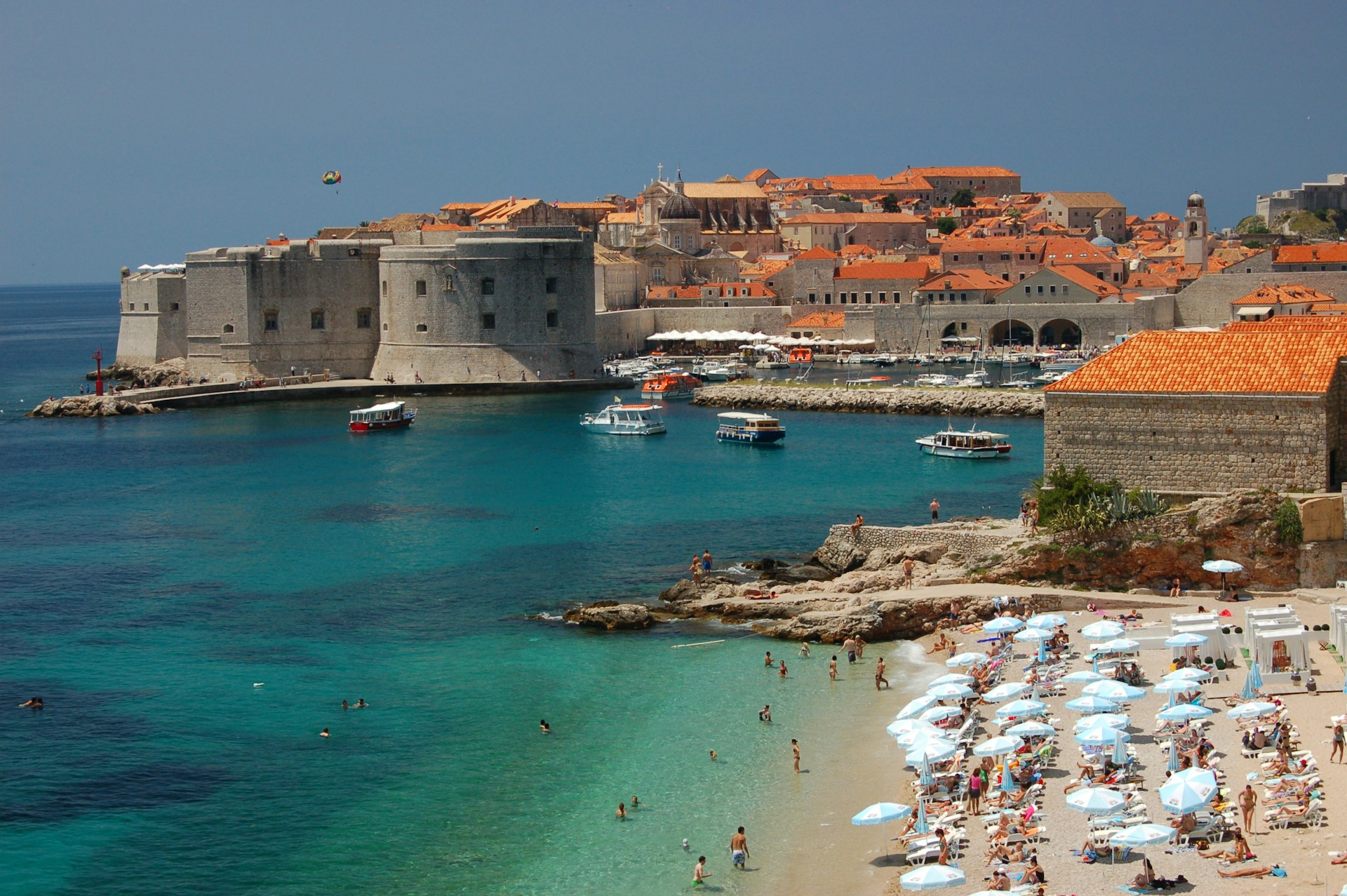
Banje is the beach in the photographs. It sits just east of the Old Town with the city walls rising behind it and Lokrum straight ahead across the water, which is a view no other beach in Croatia can offer and the reason it is busy from mid-morning onwards all summer. It is also the beach most likely to produce a mild argument about money, because a stretch of it belongs to a beach club and the loungers there cost more than people expect.
Both of those things are easy to manage once you know how the beach is laid out. Banje beach is not one thing, it is a free public stretch and a paid club stretch side by side, and the difference between a good morning and an irritating one is mostly a matter of knowing which part you are walking onto and at what hour.
Getting there from the Old Town
Leave the Old Town through Ploče Gate on the eastern side and keep going east for about two hundred metres. The beach is below the road and you reach it down a flight of steps, which are signposted and obvious once you are on the right stretch. From the middle of Stradun it is a walk of roughly ten minutes, almost all of it flat until the steps at the end.
That proximity is the whole point of Banje. You can walk out of a restaurant in the Old Town, swim, and be back inside the walls within half an hour, which is not true of Lapad or Babin Kuk. The steps do mean it is not a good choice with a pushchair or for anyone with limited mobility, and our article on whether Dubrovnik is wheelchair accessible covers better options for that.
The free part and the paid part
This is the thing to understand before you arrive. Banje has a public section where you can put a towel down and swim for nothing, and a section run as a beach club where sun loungers and parasols are rented by the day. The two sit next to each other on the same stretch of shingle and there is no barrier between them, which is why people sometimes sit down on a lounger assuming it is public and then get a surprise.
The free area is towards the southern end. Bring a towel, find a space, and the swimming is identical to the swimming the paying customers get. The club loungers are expensive by Croatian standards, noticeably more than you would pay at Lapad or Copacabana, and whether they are worth it depends entirely on how much you value shade and a waiter. If you are there for two hours in the morning, they are not.
Before you walk down the steps
Take a towel. The free stretch has no shade and nothing to lie on.
If you want a lounger, ask the price before you sit on one. They are rented by the day, not by the hour.
Go before ten in the morning or after five in the afternoon. The middle of the day in July and August is when the space runs out.
What the beach is actually like
The surface is small pebble with some sand mixed through it, which is comfortable enough to walk on but not soft. Entry into the water is over the same pebble and the sea deepens fairly quickly, so it suits swimmers more than it suits toddlers. The water is clear, as it is almost everywhere along this coast, and there is no sand in it to cloud things up.
The view is what people come for and it genuinely delivers. Swimming out thirty or forty metres and turning round to look back at the walls and the fortress of St John is one of the better experiences in the city. Lokrum sits directly across the channel, close enough that the boats crossing to it pass in front of you all day. For what it is made of compared with the other beaches here, our article on sandy beaches in Dubrovnik sets out which surfaces you will find where.
Facilities, and what Banje does not have
There is a bar and restaurant attached to the club, which serves drinks and food through the day and is open to anyone, not only to lounger customers. Showers and changing facilities exist, water sports are sold in season, and there are places to buy a drink without committing to a table.
What Banje does not reliably have is a lifeguard. Dubrovnik’s municipal lifeguard service covers only a handful of beaches each summer and the list changes from year to year, with the staffed beaches tending to be the ones further from the centre. Do not assume supervision here, particularly outside July and August, and particularly if there is any swell running. The water deepens quickly a short way out and the channel between the shore and Lokrum carries boat traffic all day, so stay inside any marked swimming area.
Mornings, evenings and the crowd
Banje changes character three times a day and the version you get depends entirely on when you turn up. Before about nine in the morning it is quiet, the light on the walls is at its best, and a handful of locals are swimming lengths. From eleven until late afternoon in high season it is full, noisy and short of space, with cruise passengers and day visitors filling it alongside everyone staying nearby.
In the evening it becomes something else again. The club turns into a bar with music and the beach fills with a younger crowd, which is either exactly what you want or a very good reason to be elsewhere. If you are after the quiet swim with the famous view, the morning is the answer and it is not close. Our article on Dubrovnik at night covers the evening side of the city more broadly.
Is Banje worth it, and what else is close
Go once, early, for the view. That is the honest recommendation. Banje earns its reputation on the setting rather than on the beach itself, and an hour there in the morning light is worth more than a full day fighting for space in the afternoon.
For the rest of your swimming there are better options a short distance away. Šulić is a small cove on the other side of the Old Town near Pile, tucked under the walls and far less known. Porporela, the pier at the end of the Old Port, is where locals swim off flat concrete with easy ladder entry and no crowd. Lapad bay is the family answer, with shallower water and room to spread out. And if you want the water without a beach at all, the cliff jumping spots and the Buža bars put you straight into deep water off the rocks.
Questions people ask
Is Banje beach free?
Partly. There is a free public section, towards the southern end, where you can lay a towel and swim at no cost. The sun loungers and parasols belong to the beach club and are rented by the day.
How do you get to Banje beach from the Old Town?
Leave through Ploče Gate, walk east for about two hundred metres and take the steps down to the beach. It is roughly a ten minute walk from Stradun.
Is Banje beach sandy?
No. It is small pebble with some sand mixed in. The water deepens fairly quickly, so it suits swimmers better than small children.
Is there a lifeguard at Banje beach?
Do not count on it. Dubrovnik’s lifeguard service covers only a few beaches each summer and the list changes, with Banje not usually among them. Treat it as unsupervised swimming.
When is the best time to go to Banje beach?
Before nine in the morning, for the light on the walls, the space and the quiet. From late morning through the afternoon in July and August it is crowded, and in the evening it turns into a bar.
Can you see the Old Town from Banje beach?
Yes, and that is the reason to go. The city walls and St John’s Fortress rise behind the beach and Lokrum sits across the channel in front of it.
Go at eight, not at two
Almost everything written about Banje beach argues about whether it is overrated, and almost all of it is really arguing about what time of day the writer went. At two in the afternoon in August it is a crowded shingle beach where a pair of loungers costs more than lunch, and the verdict writes itself. At eight in the morning it is close to empty, the walls above it are lit from the east, the water is flat and clear, and you have one of the best swimming views in the Mediterranean more or less to yourself.
So treat the hour as the decision rather than the beach. Walk out of Ploče Gate early with a towel and nothing else, swim out far enough to turn round and look back at the city, then go and have breakfast inside the walls while everyone else is heading down the steps. Keep the afternoon for somewhere with more room. Banje rewards the people who come to look at Dubrovnik from the water, and punishes the ones who come expecting a resort.
Photography: Unsplash
Get in touch:
 Whatsapp
 Send sms
 Call us
Explore Our Tours:

Taste of Bosnia: Private Trebinje Gastro & Wine Tour

From Sea to Plate: Private Oyster Farm Experience from Dubrovnik

Dubrovnik Scenic Sunset Tour with a Premium Wine Experience
Dubrovnik Panorama Tour: Small-Group Sightseeing Drive

Private Peljesac Wine Tasting Tour from Dubrovnik
