
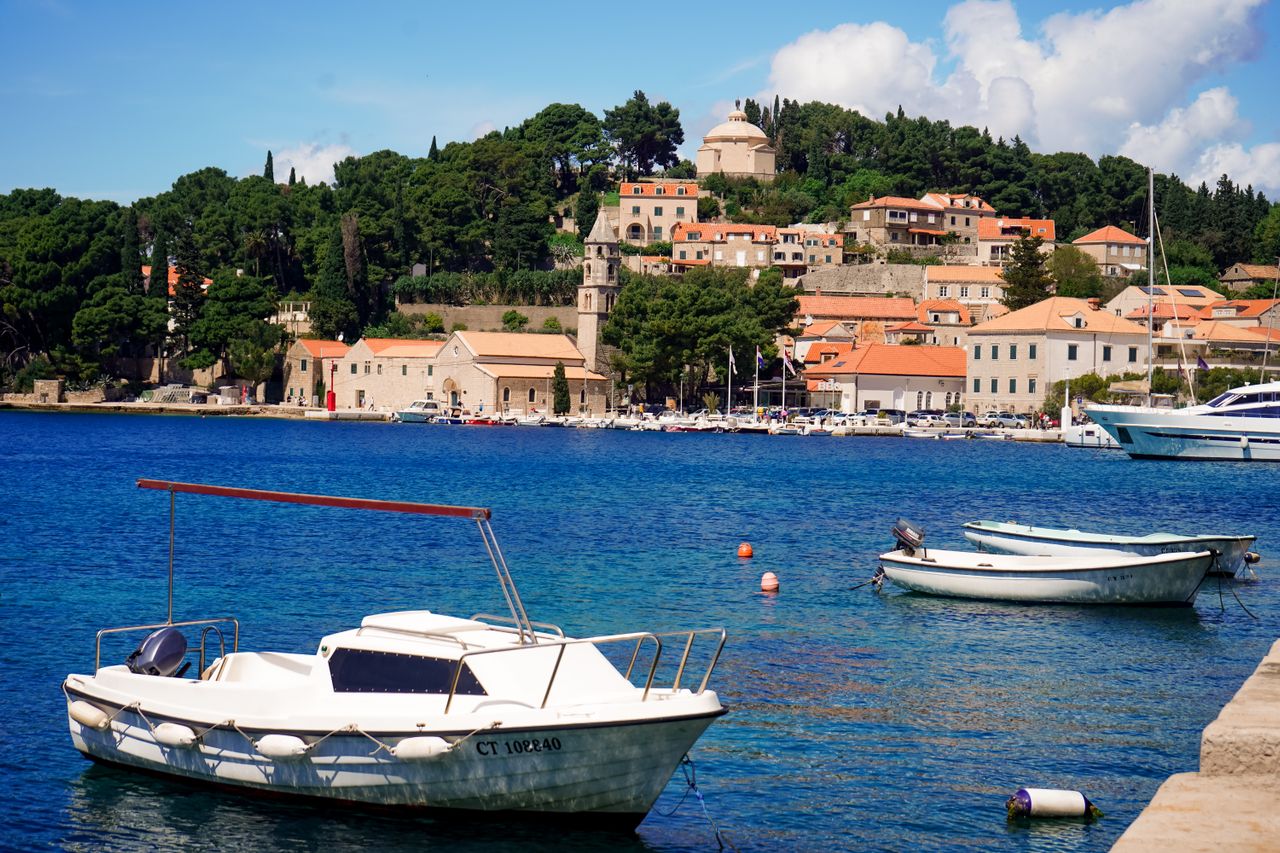
Should you stay in Cavtat or Dubrovnik?
Twenty kilometres separate the two, and almost everything else about the decision follows from that number. Cavtat is a small harbour town on two low peninsulas south of the city, close enough to Dubrovnik that people treat it as a suburb and far enough that getting in and out has to be planned rather than assumed. It is quieter, greener and easier on the wallet, and it sits a few minutes from the airport rather than most of an hour.
Whether you should stay in Cavtat or Dubrovnik comes down to three honest questions: how many nights you have, whether you will have a car and what you want your evenings to look like. We work in both places and send guests to both, so there is no particular reason for us to push one. For some trips Cavtat is clearly the better base. For others, choosing it will quietly cost you the best hours of your holiday.
How you get between Cavtat and Dubrovnik
Everything hinges on the connection, so keep it in mind before you look at a single hotel. There are three ways to cover the distance and they are not interchangeable.
The bus
Libertas line 10 is the workhorse. It runs along the coast through Plat, Mlini and Srebreno between Cavtat and Dubrovnik’s main bus station in Gruž, stopping at Pile on the way, and the journey takes roughly half an hour to forty minutes depending on traffic. Buses run regularly through the day, it is by far the cheapest option and in high season the road can be slow. Check the current timetable at libertasdubrovnik.hr before you build an evening around the last departure, because that last departure is the single most important piece of information for anyone basing themselves in Cavtat.
The boat
In season, small passenger boats run between Cavtat’s harbour and Dubrovnik’s Old Port, taking around forty-five minutes to an hour. It costs several times the bus fare and it is worth every cent at least once, because arriving at the Old Port by sea is a genuinely better way to meet the city than stepping off a bus at Pile. The caveats are real though. It operates seasonally, roughly from spring into October, the timetable changes month to month, it does not run in bad weather and it stops well before the end of a long dinner. Many people take the bus one way and the boat back.
Car, taxi and the airport
Driving takes about half an hour along the D8 coastal road. Cavtat is easier for a car in every respect: parking is simpler and cheaper, and you are outside the restricted traffic zone that Dubrovnik introduced around its historic core in 2025, which is covered in our article on whether Uber works in Dubrovnik. The airport is the other big advantage. It sits about five and a half kilometres from Cavtat, under ten minutes by car, against roughly 22 kilometres to Dubrovnik. There is no useful scheduled bus between the airport and Cavtat despite that short distance, so arrivals mean a taxi or a booked transfer, but it is a short and cheap one.
The bus is reliable and slow, the boat is seasonal and lovely, and the airport is practically next door.
What Cavtat gives you
Cavtat is not a village and it is not a resort strip. It is a proper small town with a working harbour, a palm-lined promenade and enough of its own history to fill an afternoon. The whole place is flat and walkable, which after a few days of Dubrovnik’s staircases is more of a relief than it sounds.
The two things worth seeing are both unusual. The Račić family mausoleum on the hill above the harbour is the work of Ivan Meštrović, Croatia’s best known sculptor, and it is a strange and beautiful building that most visitors to the region never hear about. Below it, the birthplace of the painter Vlaho Bukovac is now a house museum, and it is one of the more atmospheric small museums anywhere on this coast. Add the loop around the Rat peninsula, about an hour at a gentle pace with pine shade and places to swim straight off the rocks, and you have a day that costs almost nothing.
The practical gains are just as real. Accommodation generally goes further here than in Dubrovnik, you will not be sharing the waterfront with several thousand cruise passengers, and the beaches are closer to where you sleep. Žal is the main one, shingle and gently sloping, which makes it the obvious choice with small children.
What you give up
This is the part the comparisons written by Cavtat hotels tend to skip. The best hours in Dubrovnik are early morning and late evening, when the day visitors and the cruise passengers have gone and the Old Town belongs to the people in it. Those are precisely the hours you cannot easily reach from Cavtat, because the first bus and the last bus bracket your day at both ends. If you stay in the city you can walk out at seven in the morning onto an empty Stradun, and again at eleven at night. If you stay in Cavtat you will mostly see the Old Town between ten and six, which is when it is at its busiest and least appealing.
Evenings are the other trade. Cavtat has good restaurants and a handful of wine bars along the promenade, and in summer there are free open-air concerts, but the range is small and it is quiet by midnight. Dubrovnik has the variety and the late hours. Off season the gap widens sharply, because a good number of Cavtat’s tourist businesses close from November until spring, while Dubrovnik keeps working year round.
The museums are in Dubrovnik too, and so is the thing most people came for. If your trip is short, every hour on the number 10 is an hour not spent on the city walls. See our article on the best months to visit Dubrovnik for how much the season changes all of this.
In short: Cavtat costs you the early mornings and the late evenings, which are the two best times to be in Dubrovnik.
Should you stay in Cavtat or Dubrovnik for your trip?
Rather than a verdict that fits nobody, here is how the decision tends to fall for different kinds of trip.
A first visit of two or three nights
Stay in Dubrovnik. With that little time the commute eats too much of it, and the whole point of a short first visit is to be inside the walls when the city is quiet. Cavtat will still be there as an afternoon out.
A week or more, or a repeat visit
Cavtat works well. Once you have done the Old Town properly, having a calm base with swimming on the doorstep beats being in the middle of the crowds every day, and the bus becomes an occasional trip rather than a daily chore.
Travelling with young children
Cavtat, in most cases. Flat streets, a gentle shingle beach, short distances and a promenade where a four year old can run around are worth more than proximity to a fortress. Our article on Dubrovnik with kids covers the city side of that.
Arriving late or leaving at dawn
Cavtat, comfortably. A ten minute transfer after a delayed flight, or a six in the morning departure that does not start with a drive across the city, is a meaningful improvement to a holiday.
Travelling with a car
Cavtat. Parking in Dubrovnik is expensive and awkward and the restricted zone around the Old Town adds another layer to it, which our article on parking in Dubrovnik goes into. In Cavtat a car is simply easier.
Winter and the shoulder season
Dubrovnik. From late autumn a lot of Cavtat shuts down, the boat stops running and the evenings get very quiet indeed. The city stays open and keeps its restaurants, museums and buses going all year.
You cannot decide
Split the stay. Two or three nights in the Old Town at the start, when you want the early mornings, then move out to Cavtat for the rest. It is twenty kilometres, so moving costs you an hour, and you get both versions of the holiday.
Side by side
| Cavtat | Dubrovnik | |
|---|---|---|
| Distance to the Old Town | About 20 km, 30 to 45 minutes by bus | You are in it |
| Distance to the airport | About 5.5 km, under 10 minutes | About 22 km |
| Early mornings and late nights in the Old Town | Difficult, bound by the timetable | The main reason to stay here |
| Evenings | Promenade restaurants and wine bars, quiet by midnight | Wide choice, late |
| Beaches | On the doorstep, family friendly shingle | A walk or a bus ride away |
| With a car | Easy parking, outside the restricted zone | Expensive and restricted |
| Off season | Many businesses closed from November | Open year round |
| Value for money | Generally goes further | Premium, above all in the Old Town |
Cavtat as a base for days out
One argument for Cavtat rarely makes it into these comparisons. It sits in Konavle, the green southern corner of the country, and it is the closest town of any size to the Montenegrin border. If your plans include the Bay of Kotor, starting from Cavtat takes most of half an hour off the drive in each direction, which on a long day with a border crossing is worth having. Our day tour from Dubrovnik to Montenegro picks up from either.
Konavle itself is the other reason. The valley behind Cavtat has wineries, old watermills, walking and the dramatic Pasjača beach below the cliffs, none of which are easy without a car or a driver. From Dubrovnik all of that is a day trip. From Cavtat it is an afternoon. Trips further afield work from either base, including Mostar and the Kravice waterfalls and the Pelješac wine route, though those run north and Dubrovnik has the small edge.
Questions people ask
It comes down to what you want your evenings to be
Strip away the hotel marketing on both sides and the decision is not really about scenery or price. Both places are beautiful, both sit on the same stretch of coast and the difference in cost, while real, will not make or break a holiday. What changes is the shape of your day. In Dubrovnik you live inside the thing you came to see, with the crowds while they are there and the city to yourself once they leave. In Cavtat you live beside it, with calm mornings and swimming and a bus timetable quietly setting the edges of your evenings.
So the useful way to decide whether to stay in Cavtat or Dubrovnik is to picture nine o’clock at night. If that picture has you walking back through empty stone lanes after dinner, stay in the city and accept the crowds and the price. If it has you on a harbour front with a glass of wine and nowhere to be, Cavtat is the better answer and it is not close. And if you have a week, there is no rule that says you must choose only one. Two nights inside the walls followed by five in Cavtat is, for a lot of people, the version of this trip that works best.
Photography: Pexels
Get in touch:
 Whatsapp
 Send sms
 Call us
Explore Our Tours:

From Sea to Plate: Private Oyster Farm Experience from Dubrovnik

Taste of Bosnia: Private Trebinje Gastro & Wine Tour

Montenegro day trip from Dubrovnik

Plitvice Lakes, National Park, Day Trip from Dubrovnik

Dubrovnik Night Drive: Lights of the Adriatic
