
Currency exchange in Dubrovnik
Croatia has used the euro since January 2023. If you are coming from another eurozone country, your cash already works here and you can skip most of this page. For everyone else, changing money in Dubrovnik is not complicated, but a few small mistakes can quietly cost you extra euros without you noticing.
This page covers where to change money in Dubrovnik, how to tell a fair exchange office from one that is not, and what to do in a few situations that trip people up: leftover kuna from an old trip, a currency the local offices do not usually stock, or a day trip across the border to Montenegro or Bosnia.
Where to find currency exchange in Dubrovnik?
Banks
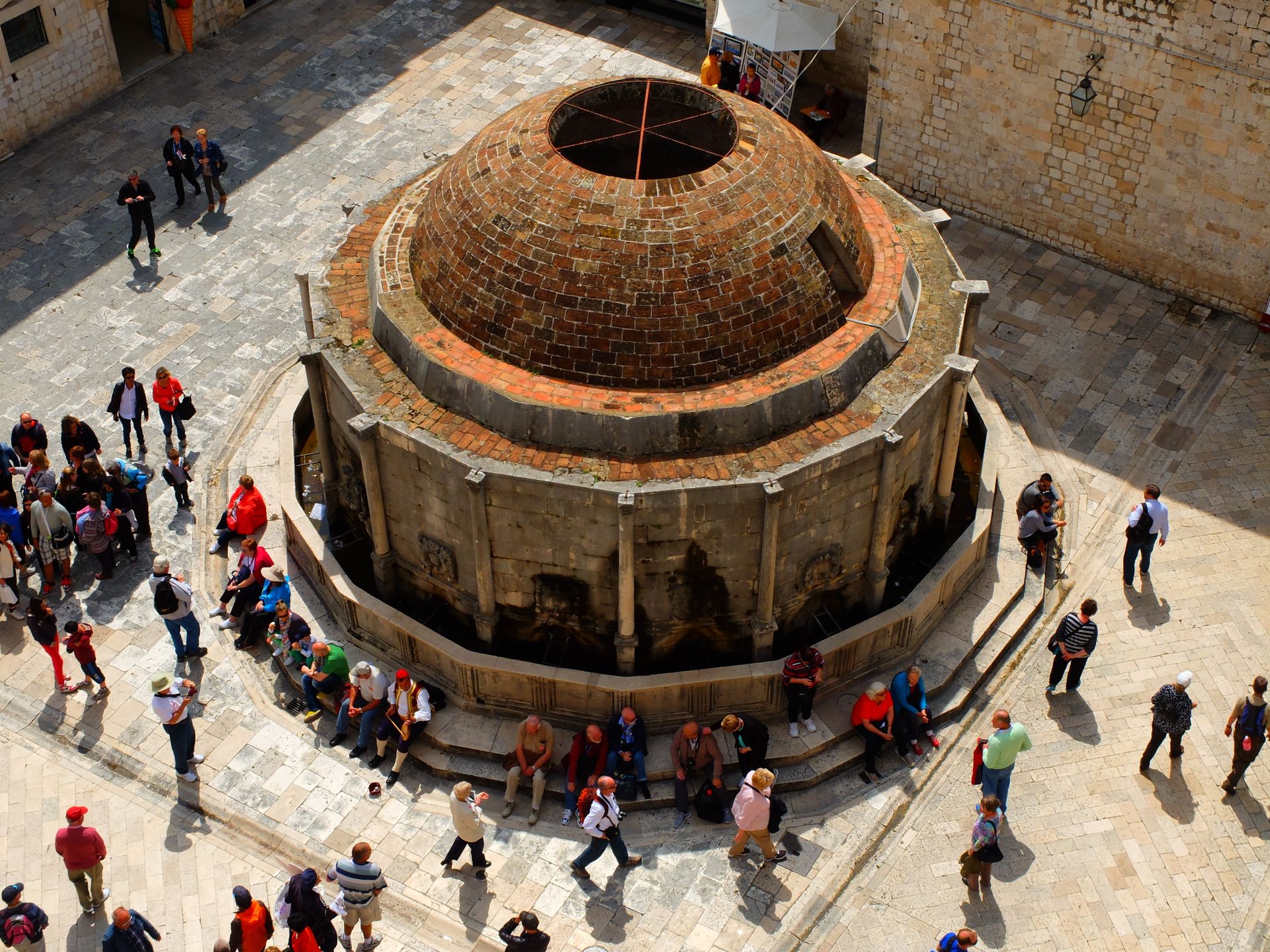
Branches of OTP, PBZ, and Zagrebačka banka sit right on Stradun, the Old Town’s main street, and there is a cluster near Pile Gate too. Banks usually give the most transparent rate, so they are a safe default if you are not sure where else to go.
Mjenjačnice (exchange offices)
These are the standalone exchange offices most people think of first. You will find several inside the Old Town alone, with more near the bus station and the ferry port at Gruž. They tend to stay open longer than banks, but the rate can vary a lot from one office to the next, so it is worth comparing before you commit.
Hotels
Most hotel front desks will change cash for you, but the rate is usually the weakest of all your options. It only really makes sense if nothing else is open and you need a small amount right away.
Airport counters
You can exchange money the moment you land, since there are counters open in the arrivals hall for international flights. The rate here tends to be the worst in the whole city, though, so it is worth waiting until you reach the city centre if you can.
|
Option |
Typical rate |
Convenience |
Best for |
|---|---|---|---|
|
Bank branch (Stradun, Pile Gate) |
Transparent, usually fair |
Limited to opening hours |
Larger amounts, peace of mind |
|
Mjenjačnica |
Varies, check before committing |
Long hours, widely available |
Small amounts, after-hours needs |
|
Hotel front desk |
Weak |
Very convenient |
Only when nothing else is open |
|
Airport counter |
Weakest |
Available right on arrival |
Only if you truly can’t wait |
Opening hours, including weekends
Banks keep standard business hours and close on Sundays, so don’t plan around one being open for a weekend top-up. Mjenjačnice are more flexible; many in the Old Town stay open seven days a week during the main season, though hours can shrink outside summer and later in the evening than you might expect. If a specific office matters to your plans, it’s worth a quick phone check rather than assuming it keeps the same hours all year.
Below you can find a map of banks in Dubrovnik. Clicking on each one provides the information about opening hours and exact location.
Most of what you need is within a five-minute walk of Stradun, so you rarely have to go far out of your way for it.
How to spot a trustworthy currency exchange office?
A trustworthy currency exchange office in Dubrovnik shows its buying and selling rates openly, gives you a straight answer about commission, and hands you a receipt without being asked. Here is what that looks like in practice.
- Check the rate board before you hand over any cash
Some mjenjačnice advertise “no commission” or 0% provizija in big letters in the window. That part can be true, but it does not mean the deal is good. Instead of charging a separate fee, these offices sometimes just set a weaker rate, so the real cost is hidden inside a number you never see written down. Every licensed mjenjačnica in Croatia has to display its buying and selling rates on a board, so check it before you agree to anything. - Ask a direct question about commission
A simple question, “is there a commission, or is it all in the rate?”, tells you a lot. A trustworthy office answers without hesitating. If the staff seem unwilling to explain, or they rush you to decide quickly, it is worth walking to the next office instead, since they are rarely more than a few minutes apart in the Old Town. - Compare against a bank rate first
Before exchanging anything, it helps to check what a bank on Stradun is offering. If a mjenjačnica’s rate is far worse than the bank’s, that is a clear sign to skip it. This one habit, checking a bank rate before you commit to a mjenjačnica, is the single easiest way to avoid losing money on a poor exchange. - What a bad rate actually costs you?
The difference between a poor exchange and a fair one is easy to underestimate because it’s hidden in a rate rather than a fee. As a rough example, exchanging €500 worth of foreign cash at an airport counter instead of a well-reviewed mjenjačnica or a bank can easily cost you somewhere in the range of €15 to €25, sometimes more, depending on how wide the spread is. That’s a real dinner out, lost to a five-minute decision made at arrivals because it felt convenient at the time. - Always get a receipt
A legitimate office gives you a printed receipt automatically, without you having to ask. If a place does not offer one, treat that as a warning sign.
It also helps to check Google Reviews before you go, not just for the star rating, but for what recent visitors actually say about the rate they got. Money Exchange Mjenjačnica near the bus station and harbour on Obala Stjepana Radića comes up often in reviews from travelers who compared it against two or three other places nearby and found it consistently gave a better rate on British pounds and US dollars. Check its location on the map below.
A pattern like that in recent reviews tells you more than any sign in a window. Names and locations of individual businesses can change, so it’s worth a quick check that this one is still operating and still well-reviewed before you go out of your way for it.
Where never to exchange money?
Avoid these entirely:
- Anyone offering to exchange cash on the street, however good the rate sounds
- Taxi drivers offering to change money for you
- “Friends of a friend” or informal contacts arranged through your accommodation
- Unlicensed booths without a visible rate board or storefront
Legitimate currency exchange in Dubrovnik only happens through banks, the post office, and licensed mjenjačnice with a visible license and a real storefront. One more thing worth knowing: don’t let anyone pressure you into exchanging money immediately after you arrive, whether that’s at the airport, the bus station, or the ferry port. A rushed decision in an unfamiliar place is exactly how people end up with a bad rate they didn’t have time to question.
Dynamic currency conversion
Whenever a card machine or ATM asks whether to charge you in euros or your home currency, always choose euros. This prompt, known as dynamic currency conversion or DCC, shows up at card terminals in restaurants and shops just as often as it does at ATMs. It might be phrased as “Charge in EUR” versus “Charge in USD” or “Charge in GBP”, and the home-currency option is almost always the wrong one to pick.
The logic is simple: choosing your home currency hands the conversion to the merchant’s payment processor, which typically uses a worse exchange rate and adds its own margin on top. Choosing euros instead means your own bank handles the conversion, usually at a meaningfully better rate. In one sentence: let your own bank do the conversion, not the machine in front of you. This single habit is arguably the most valuable piece of advice on this entire page, since it applies to every card payment and ATM withdrawal you make in Croatia, not just cash exchanges.
Exchanging less common currencies in Dubrovnik
Major currencies, such as US dollars, British pounds, Swiss francs, and Australian or Canadian dollars, are easy to exchange almost anywhere in Dubrovnik. Less common ones are more hit or miss. Japanese yen, for example, is not always kept in stock by smaller mjenjačnice, so you may need to try a couple of offices, or a bank branch, before you find one that handles it. The larger exchange offices near Stradun and the bus station are usually your best chance for anything outside the common list.
If you are carrying a currency that is genuinely uncommon in Europe, it is safer to convert it to euros or US dollars before you leave home rather than count on finding someone in Dubrovnik who will take it.
Can you exchange euros back into your home currency?
Yes, most mjenjačnice and banks in Dubrovnik will buy euros back into your home currency, just as they sell them. If you land with leftover cash from an earlier trip, or you simply brought more euros than you needed, the same rules apply as before: compare the buying rate at two places, ask about commission, and get a receipt.
It is often cheaper to just bring the leftover euros home and exchange them at your own bank there, or spend them on a future trip to the eurozone, rather than converting twice and losing a little value each time.
Still have leftover Croatian kuna?
Kuna banknotes can still be exchanged for euros, with no time limit, but only at the Croatian National Bank (HNB) in Zagreb, not anywhere in Dubrovnik. No shop, restaurant or business anywhere in Croatia accepts kuna as payment anymore; it stopped being legal tender back in 2023, so don’t expect to spend it directly no matter how small the amount.
If a drawer somewhere still has kuna notes from before 2023, here is the detail. Kuna banknotes remain exchangeable free of charge, but only at HNB in Zagreb, at the fixed rate of 7.53450 kuna to 1 euro. Kuna coins are no longer exchangeable at all; that option ended at the close of 2025.
In practice, this means there is nothing you can do with old kuna during a trip to Dubrovnik itself. If it is a meaningful amount, it may be worth posting the banknotes to HNB by mail, which they accept for smaller amounts, rather than planning a special trip to Zagreb just for this.
Currency exchange for day trips to Montenegro and Bosnia
If a day trip to Kotor, Mostar, or Trebinje is part of your plans, it helps to know that the region does not run on one currency, even though it can feel that way from Dubrovnik.
Montenegro is simple: it adopted the euro on its own back in 2002 and has used it as its only official currency ever since, even though it is not an EU or eurozone member. Your euros work exactly as they do in Croatia, with no exchange needed.
Bosnia and Herzegovina (Mostar, Trebinje) is different. The official currency there is the convertible mark (BAM, or “KM”), pegged to the euro at a fixed rate of about 1.955 KM. You can pay in euros almost anywhere aimed at tourists, but you will usually get your change back in marks, and often at a rate that favours the shop rather than you. If you plan to buy anything at Mostar’s Old Bridge craft stalls, or grab a coffee away from the main tourist street, having a small amount of KM on hand saves you from losing a little money on the conversion every single time you pay.
The simplest plan for a Dubrovnik, Mostar, Kotor style trip is to bring euros for everything, and if you stop in Bosnia, change or withdraw a small amount of KM once you arrive rather than paying the “euro tourist rate” all day.
Do you actually need to exchange cash at all?
If you mainly pay by card, you may not need a currency exchange office at all. Cards, Apple Pay and Google Pay are accepted almost everywhere in Dubrovnik, and for most short trips a bank ATM withdrawal covers whatever cash you do need, usually at a better rate than a mjenjačnica offers on paper currency.
How much cash should you carry?
For most visitors, €20 to 50 in cash covers what a card won’t, with more if you plan to shop at markets or tip generously. A rough breakdown of where that goes:
- Coffee and small café bills, where cash is often just as easy as card
- Bakery and market stalls, some of which are cash-only
- Taxis, particularly older or independent drivers rather than app-based rides
- Tips, which are almost always given in cash rather than added to a card payment
If you’re travelling with children, it’s worth keeping a little extra on hand for the small, spontaneous purchases that come up around a family, an ice cream from a stall, a market snack, that a card feels like overkill for.
Cards, Apple Pay, Google Pay and Revolut in Dubrovnik
Cards are accepted almost everywhere in Dubrovnik, and Apple Pay, Google Pay and cards issued by Revolut or Wise all work exactly like any other Visa or Mastercard. You don’t need to do anything special to use them, and they’re generally the most straightforward way to pay throughout your trip.
A handful of situations still lean cash-first, so it’s worth having some on hand rather than assuming a card will always work:
- Market stalls and small produce sellers
- Beach bars and kiosks, particularly at less developed spots
- Bakeries and small takeaway counters
- Older, family-run restaurants outside the main tourist streets
- Some parking machines and meters
Whether American Express is accepted is far less consistent than Visa or Mastercard; not all restaurants and shops in Dubrovnik take it, so it’s worth having a Visa or Mastercard as a backup if that’s your main card.
Common money problems tourists run into in Dubrovnik
Beyond the exchange rate itself, a few complaints show up again and again in traveler forums. Here is what actually catches people out, and how to plan around each one.
- “My card got declined and I had no cash backup”
This is one of the most common frustrations visitors report. Croatian card terminals are almost always chip-and-PIN, so an old-style magnetic swipe card, or a card your bank has not cleared for travel, can fail without warning. It helps to call your bank before you go to flag your travel dates, and to carry a second card plus a small amount of cash as backup, so one declined card does not leave you stuck mid-meal. - “This restaurant added a fee for paying by card”
Although most restaurants in Dubrovnik accept cards without any surcharge, it’s worth checking in advance at smaller, family-run establishments, since payment policies can vary and a card surcharge does occasionally turn up on the bill. It’s not the standard experience, just a possibility worth being aware of rather than something to expect at every meal. - “My accommodation only takes cash”
Small, family-run apartments and guesthouses inside the Old Town walls are more likely to be cash-only than hotels are. If you have booked private accommodation, it is worth checking their payment policy in advance instead of assuming a card will work at check-in. - “The Dubrovnik Pass and city walls ticket office wanted cash”
Some visitors have been caught out buying the Dubrovnik Pass or city walls tickets at the tourist information office, expecting to pay by card. It is worth carrying cash specifically for this, even if you plan to pay by card everywhere else. - “The ATM would not give me as much as I wanted”
Many Croatian ATMs cap a single withdrawal below what you might expect, so a larger amount can take two or three separate withdrawals, each with its own fee if your card charges one. If you know you will need a larger sum, it is worth planning for that instead of being surprised by a limit on the screen. - “I arrived late at night and everything was closed”
Banks and most mjenjačnice keep standard business hours, and even the airport counters are not guaranteed to be open for every late arrival. If your flight lands in the evening, bringing a small amount of cash from home covers you until morning.
A few habits worth building before you go
- Compare two options before a larger exchange
For anything more than a small amount, check two places first, a bank and a mjenjačnica, or two mjenjačnice, rather than using whichever one you happen to walk past first. - Ask for the rate before you commit
Ask what rate you are getting before you hand over cash, not after the transaction is already done. Once the money has changed hands, there is nothing to negotiate. - Bring a small amount of cash from home
If you are arriving late at night, having enough for a taxi or a coffee saves you from hunting for an open bank or mjenjačnica at an odd hour. - Consider a bank ATM over paper cash
If your card does not charge heavy foreign fees, withdrawing euros from a bank ATM is usually cheaper than exchanging paper cash at all. Our article on ATMs in Dubrovnik covers which banks to use and which machines to avoid.
Two minutes of prep saves you the rest of the trip
None of this takes much effort once you know it. The pattern is almost always the same, regardless of if you are standing at a mjenjačnica on Stradun or a bank counter near Pile Gate: look for a posted rate, ask about commission before you hand over cash and get a receipt. That takes about as long as ordering a coffee, and it is the difference between losing a few euros to a bad rate and never thinking about it again for the rest of your trip.
If you like to have this fully sorted before you land, the simplest plan is this: pay by card for most things, choose euros whenever a machine asks which currency to charge you in, and withdraw a modest amount of cash from a bank ATM for whatever a card cannot cover. Everything else, a market stall, a coffee on a side street off Stradun, an occasional cash-only konoba, sorts itself out from there.
Frequently asked questions
Photography: Pexels
Get in touch:
 Whatsapp
 Send sms
 Call us
Explore Our Tours:

Private Peljesac Wine Tasting Tour from Dubrovnik

Taste of Bosnia: Private Trebinje Gastro & Wine Tour
Dubrovnik Panorama Tour: Small-Group Sightseeing Drive

Plitvice Lakes, National Park, Day Trip from Dubrovnik

Dubrovnik Scenic Sunset Tour with a Premium Wine Experience
